


 IOS
IOS
 Android
Piggy Kingdom by olleyo uses a dual progression system, whereby by passing match-3 puzzle levels, one can earn stars, which are used to then fix up and restore a run-down pig castle and its grounds. Although a lot of match-3 games include meta-progression, the way Piggy Kingdom uses renovation mechanics can demonstrate some intriguing design philosophies regarding the player choice, storyline and long-term motivation.
The renovation concept begins promisingly. Players begin with a shabby estate of a huge castle that needs to be restored. First stars open the gates of garden beauty--weeds are ruthlessly raked, ornamental fountains are planted, ornamental bushes, and walks made. The visual remodeling is an instant gratification because the kingdom slowly changes the state of abandonment to restoration full of life. Each completed renovation task reveals the next objective, creating a breadcrumb trail of goals extending beyond individual puzzle completion.
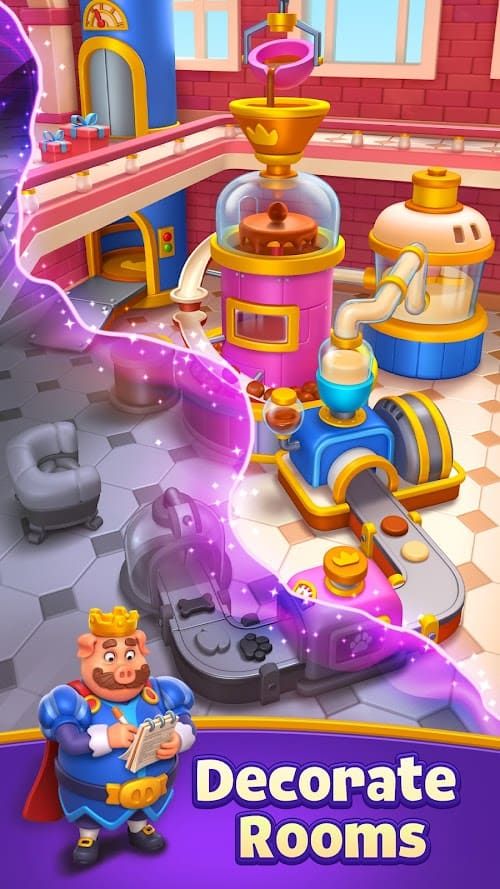
As players progress, renovation expands from exterior grounds into interior castle spaces. Stars are able to open furnishings, armchairs, tables, bookshelves, lamps, and decorations that fill up the empty rooms. The interior renovation theoretically provides deeper engagement, as players witness not just landscape improvements but livable spaces taking shape. This progression from outdoor to indoor creates natural pacing, with exterior work establishing the kingdom before revealing its detailed interior personality.
The primary advantage of Piggy Kingdom's renovation system is its clarity and consistency. Unlike games offering multiple simultaneous renovation projects, Piggy Kingdom presents single linear tasks requiring specific star quantities. This simplicity eliminates decision paralysis—players always know exactly what they're working toward and how many stars remain necessary. For players who find excessive choice overwhelming or who prefer clear objective structures, this streamlined approach provides comfortable guidance through potentially hundreds of levels.
The renovation system also creates effective milestone celebrations. Completing major renovation sections—finishing an entire garden area or furnishing a complete room—delivers satisfaction beyond individual level completion. These moments provide natural stopping points where players can appreciate accumulated progress before continuing. The visual before-and-after contrast makes time investment feel productive rather than merely consumptive, addressing common criticisms that match-3 games lack meaningful accomplishment.
However, critical disadvantages emerge from the renovation system's rigid linearity. Piggy Kingdom offers zero player choice in decoration styles, color schemes, or furniture selection. Unlike competitors such as Homescapes that present multiple design options for each renovation task, Piggy Kingdom's predetermined aesthetic eliminates personal expression. Players cannot imprint individual taste onto their kingdom—every player's castle looks identical, removing a powerful personalization motivation that drives engagement in similar games.
This lack of agency extends beyond aesthetics to strategic planning. Players cannot choose which areas to renovate first, cannot skip uninteresting tasks to prioritize preferred projects, and cannot influence the kingdom's development direction. The renovation becomes a purely passive reward dispensary rather than an interactive creative system. Players work toward goals they didn't choose, implementing designs they didn't select, following a narrative path with no branching possibilities.
The renovation narrative itself remains superficial. Unlike games that develop character relationships or evolving storylines through renovation progress, Piggy Kingdom treats restoration as mechanical checklist completion. No meaningful story explains why this particular pig needs this particular castle restored, what narrative stakes exist, or how renovation choices might affect future outcomes. The lack of narrative depth makes renovation feel like arbitrary busywork rather than purposeful story progression.
Furthermore, the star economy creates frustration when renovation tasks require multiple stars while difficult levels make star acquisition increasingly challenging. Players may spend hours on a single difficult level, finally succeed, then discover their hard-won star represents merely one-third of the next renovation task's cost. This mismatch between effort and reward diminishes renovation satisfaction at precisely the moments when players most need motivation to continue.
By Jerry | Copyright © Game-Nook - All Rights Reserved